


September 17, 2026
New automation tools for your clinic. Webinar in collaboration with Ovianta.Discover how to automate your clinic's management and phone support without losing that personal touch with your patients.
After the expectation that aroused the Roundtable about How to start from scratch in psychology, we decided to open a call Q&A to answer specific questions and resolve doubts.
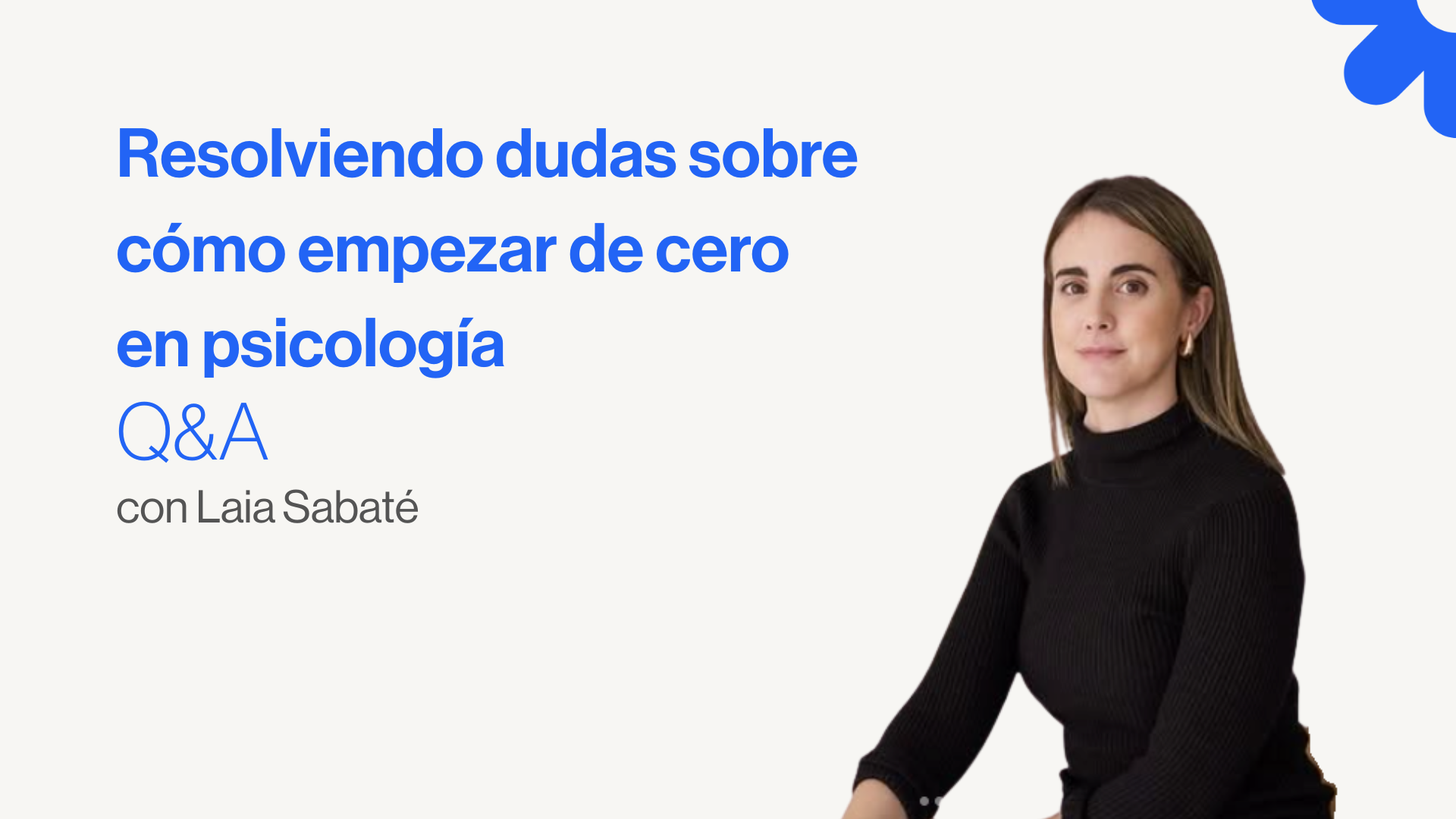
We asked registrants to send their questions and the session was 100% focused on resolving them. The influencer psychologist Laia Sabaté he answered masterfully based on his extensive experience and knowledge.
Question: I don't have my theoretical line 100% defined yet. Is it good to specialize? In what and how do I choose it if I'm not sure?
Laia Sabate: This is a very important issue. When we talk about the theoretical line, we usually refer to the psychological current.
In my case, during my degree I was interested in some currents that were not the main focus of what I was studying. They caught my attention, but I didn't know them well enough to know if I would really like them or not.
I specialized in currents long after I started exercising. Partly because one thing is what you think and another is what you find in daily practice. The experience changes the perspective a lot.
When you study the degree and master's degree in General Health Psychology, or any other master's degree, there is usually already a current — usually behavioral — that allows you to start working. With that you are more than ready to exercise.
Anything you want to add later is positive. For me, in addition, it is a very good option to add elements to that initial flow. But I think it's important to start looking at cases to understand the real meaning of each approach, why you choose a current and why it can serve you better.
Even so, even if with practice there is one that you end up liking the most, I don't think it's essential that you like it as such, but that you see it as useful for patients.
I don't think it's that important to choose a single current from the start. I think it's important to know several, test them and, over time, build your own integrative model. It's normal not to know which one you identify with the most when you're starting out and you haven't seen the real differences in practice yet.
Q: Is it worth taking a master's degree in General Health Psychology?
L.S.: Absolutely yes, if you want to exercise. I think we've all been through that moment of anger, of thinking that you don't want to do it, of feeling that it's very similar to what you've already studied. I went through that phase too. I said I didn't want to do it, but when they called me I thought it was better to do it.
Nowadays it is very difficult to exercise without having one, both on your own and on someone else's behalf. I know that there are legal loopholes, but I recommend doing so if you can, even if it's complicated by price or note.
Especially since you will have many more job offers to access, especially in the healthcare-clinical field, and also for your own peace of mind as a professional. I don't think that a profession like ours should be sustained by shenanigans. It's not the best way to work.
Q: What do you have to understand in order to make a living from psychology?
L.S.: It's an intense question. To make a living from this, there are several areas to consider. The first thing that comes to mind is to advise you very well, because it means having a salary sufficient to live in a world that is now expensive.
Good advice, training and taking care of all the professional aspects is key. But it's also a profession in which people burn out a lot, as is the case in health or education. Many times we come in with a lot of need to work and we assume very large loads, such as 40 patients a week, and that is very complicated.
We can't do eight-hour care days. In addition to tax advice and training, it is important to understand that it is a delicate profession, not only because of the patients, but because of what we experience in the processes.
It is essential to take care of ourselves and understand our limits. If you do things right, word of mouth ends up coming on its own.
Q: How to start from scratch without experience?
L.S.: I don't recommend starting directly on your own. It is very difficult to do this without experience or contacts, not only professional, but human.
I started out as an employee and it worked really well for me. I understood that if I wanted to work with people, I had to have jobs, volunteers and experiences related to people, even though I couldn't say in my resume that I was working as a psychologist.
That generates real experience: dealing with families, with children, with people. And those skills aren't that different from what you later need in consultation.
If work doesn't come out in a center, starting with related experiences is climbing the ladder. In psychology, there aren't many middle ranges: either you're a psychologist or you're not. Those previous ranks are related experiences.
I also highly recommend the online part because of the lower initial investment. Setting up a center or renting an office involves a large investment that you don't know if you're going to recover.
Nowadays there are two main ways to get patients: advertising or content generation. And it's also important to talk about what you do with your environment, because many opportunities arise that way.
Q: What mistakes should I avoid when starting out?
L.S.: The first is taking in too many patients.
Another mistake is to want to be 100% clear from the start where you are going to be. We have many years to specialize and we need to try things out.
Specializing in the beginning should not entail an excessive economic burden. It's not a good idea to spend money on many official formations without knowing yet where you're going. It's best to start with smaller, more practical and accessible training.
Even so, training is an important economic investment. Since we cannot do everything, it should be something that really interests us when we do training.
And, above all, the biggest mistake, especially if we work as freelancers, is not advising ourselves well. Sometimes psychologists are very vocational and we stay in the beautiful part of the profession, but we are not playing at having a business: we are having a business. You have to understand how being a freelancer or a company works.
Q: How to set goals in the first session and follow up on them?
L.S.: The objectives seem very important to me, but I think they should be approached with great humility at the beginning.
What the patient brings in the first session doesn't always end up being the most important thing to work on. Often the reason for consultation is disbanded and other questions appear.
Therefore, the objectives of the first day are often not objectives, but hypotheses: we may have to work on this or that.
During the race, they taught me an exercise that I continue to use mentally. The first thing is to listen to the patient. Stop being in the psychologist's mind all the time thinking about what to say or what to do and really listen to what his suffering is and what is happening to him.
From there, you begin to make hypotheses: if it is related to childhood, to a negligent relationship, to work, to physical health. These hypotheses must be kept present and related to the information that appears.
For follow-up, it is enough to listen very well and end up understanding what is happening to him, what you think has happened to make him that way and what he needs to change to improve his quality of life.
It is useful to have that first “page” in the medical record with the hypotheses and the direction of the process. Thus, any topic that appears can be linked to that focus and the process does not become chaotic, especially in long processes.
Q: How to get more patients, especially online?
L.S.: The first thing is to analyze what needs exist in your neighborhood or area, how many centers there are, what they offer and how you can differentiate yourself.
When you are clear about what is needed, you have to go to the places related to that: schools if you work with children, collaborations with other centers, create community.
Our work is lonely, but recruiting patients can't be. Word of mouth works: leaving cards, collaborating with other professionals, creating a network.
In the online environment, there are three main ways:
Social networks are not about selling services, but about connecting with people, understanding them and explaining what is happening to them so that they understand each other better. People want to choose their psychologist and they need to see how you talk, how you think and how you connect.
It should not be done in a commercial way, but genuinely. Networking just for the sake of doing doesn't work; there has to be a real connection.
The fear of not having enough patients doesn't go away. There are no guarantees, but trying hard increases the odds. You have to be realistic, know how much risk you can take and strive within that margin, integrating reason and emotion.
Q: What percentage of patients arrive through social networks compared to web positioning?
L.S.: 90%. Within the online world, 90% arrive through social networks. Outside of online, there is also a lot of word of mouth. I don't advertise currently; at first I did, in 2020. We know where they come from because we asked them in the form.
Social networks were what allowed me to start a business. It doesn't mean that more people are always better. The important thing is to find a way to become visible that you are comfortable with.
Q: How do collaborations in psychology work?
L.S.: There are two ways to scale: hiring or collaborating with freelancers. Collaborations are between freelancers and are legal if done well. If the conditions are those of a worker with a collaboration contract, it's not right. If the person is truly autonomous, with their schedules, their decisions, charges the sessions and then commissions, then yes.
Q: How to manage schedules and limits?
L.S.: It's a complex issue. We have a profession with more late than tomorrow and it's easy to end up without structure.
The problem is not the schedule itself, but the division of spaces. It has to be clear when you work and when you rest. Free time is also important.
If you're a startup and want to work a lot, that's fine, but there should be at least one hour a day clearly free, without WhatsApp or emails. When you rest, really rest.
Q: Any key final recommendations?
L.S.: Good tax and employment advice is essential. Separate accounts, know what comes in and what comes out, and let Excel be your friend.
And, to close, focus on contributing and not just on getting customers. If you are an online entrepreneur, networks will be part of your daily life. Try to find meaning and consistency with who you are and how you want to help.
In Eholo, we continue to organize training sessions and webinars on all topics that concern psychologists, whether they are new professionals or experienced. La electronic invoicing Or the Application of AI are some of the topics we offer. Are you interested? Stay tuned for the schedule of new formations and... we hope to see you there! ;-)

Explora las últimas novedades
Discover how to automate your clinic's management and phone support without losing that personal touch with your patients.
You’re back from vacation with a full inbox. The key: don't respond quickly, organize first. Sort by urgency and find some calm in your return to September. 🍂
A practical guide to switching software for your psychology practice without losing records, billing, or patient information.


.webp)
.webp)
.webp)
.webp)
Virginia Lagartos Lopez
April 12, 2024
.webp)
Maria De Salazar Martínez
September 01, 2023
.webp)
April 2, 2024
.webp)
April 3, 2024
.webp)
January 22, 2025
Más de 10,000 psicólogos ya confían en Eholo para gestionar sus consultas.
.png)
Necesitamos saber esta información para personalizar tu demo:
