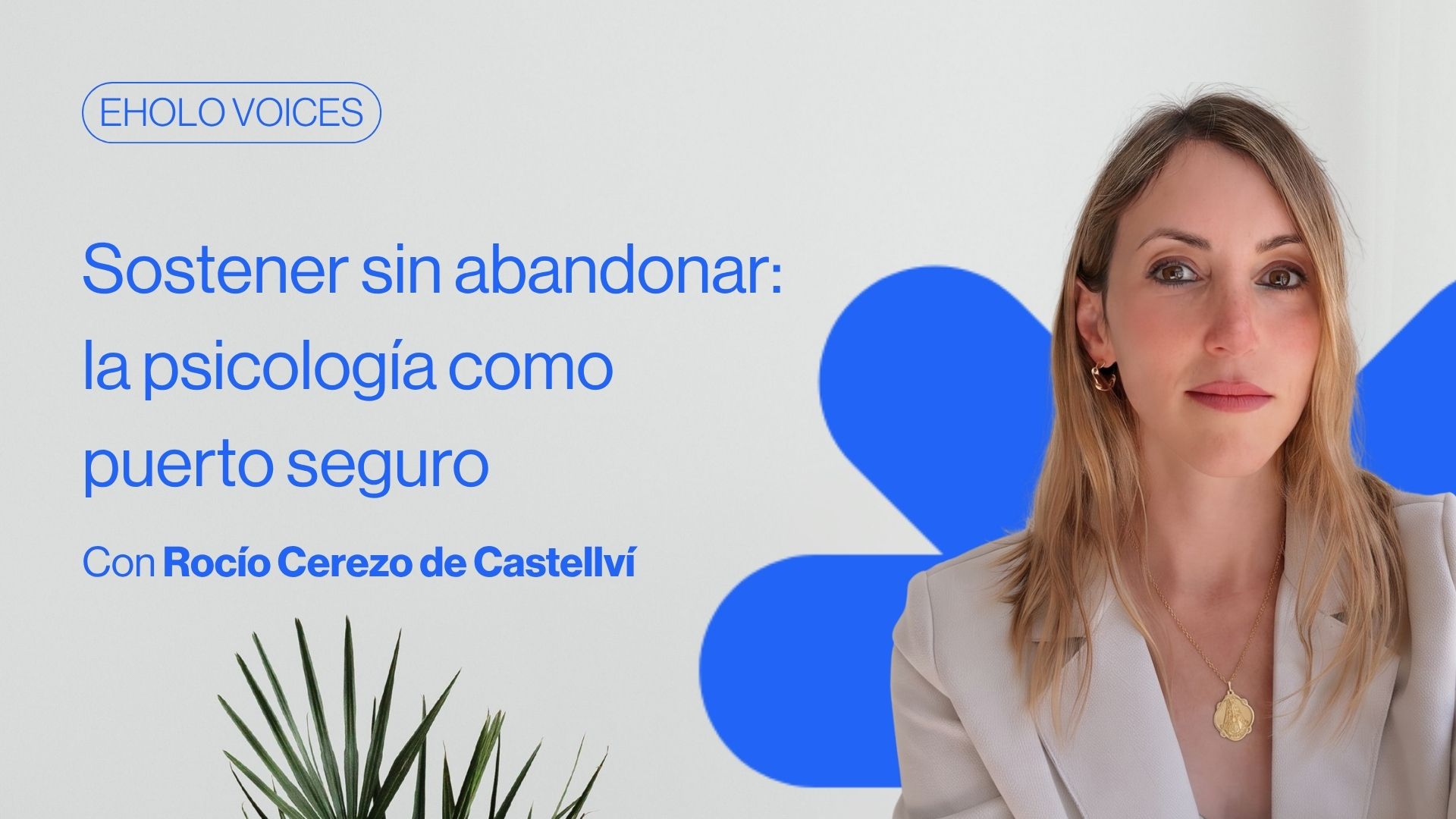
Holding space without abandonment: psychology as a safe harbor
"Family must always be the priority."
Rocío Cerezo de Castellví is a psychologist with an integrative approach that combines psychodynamic and cognitive-behavioral therapy. Her clinical work focuses on supporting complex cases: patients with multiple diagnoses, deep-seated attachment disorders, and long histories of abandonment, both within their families and by the healthcare system itself.
In this Eholo Voices interview, Rocío shares one of the most significant therapeutic journeys of her career, where she believes the profession is heading, and how she envisions her practice five years from now.
An approach that combines depth with practical tools
Rocío’s work is built on an integrative foundation: she uses psychodynamic elements to understand the root of the distress and cognitive-behavioral tools to address it in the present. This combination allows her to adapt to patients with complex histories without losing sight of either the "why" or the "how" of the therapeutic process.
The greatest challenge: being a safe harbor
One of the most demanding cases of her career involved supporting a patient with multiple diagnoses and a profound attachment disorder, marked by abandonment—not only by her family but also by the healthcare system she had experienced. This was a patient who would, at times, become very aggressive during sessions.
"Without taking her reactions and her way of relating personally, I served as her safe harbor for a time, until she decided to end therapy."
The result, according to Rocío, was something not always achieved in such cases: for the first time, the patient had an experience of not being abandoned.
A very interesting resource
For Rocío, Eholo is:
"A very interesting resource."
An assessment that echoes a common sentiment among psychologists using the platform: technology as a support tool, not the main focus, allowing them to concentrate on what happens inside the therapy room.
What’s next: artificial intelligence and the integrative approach
Rocío sees the future of the profession being shaped by technology, without losing sight of the foundation of clinical work:
"AI, digitalization, and an integrative approach."
Three ideas that, for her, are not mutually exclusive: digitalization can perfectly coexist with a deep, personalized approach to every patient.
Envisioning the practice five years from now
Her vision isn't about growth or changing direction, but rather consolidating what is already working:
"Fully booked, just like now, with more options for supervision and ongoing online training."
A practice running at full capacity, but with more room to continue training and rely on supervision—two pillars Rocío considers key to sustaining processes as demanding as the ones she describes.
Inspiration and role models
💭 If I weren't a psychologist… — "I would be a psychiatric nurse, which is what I was before."
💬 A quote that shaped her life — "Family must always be the priority."
👑 An unexpected role model — Carmen Lomana. "Despite the criticism, she is a woman who has been through very traumatic experiences, possesses brilliant self-esteem, is highly cultured, has managed her assets in an enviable way, and faces criticism with an integrity that nothing can stop."
✨ Professional role models — Javier Urra and Lara Ferreiro. "Javier Urra for his professional dedication to childhood and adolescence, and Lara Ferreiro for having known how to scale her business so successfully."
Learn more about Rocío
🔗 Rocío Cerezo de Castellví