Choosing management software for a psychology practice or center is a decision that impacts daily operations for years to come. Scheduling, clinical records, billing, consents, reminders: everything goes through it.
The market offers a wide range of options, with different prices, approaches, and functionalities. Some are designed for any healthcare professional, while others are specific to psychology. Some prioritize administrative tasks, others clinical aspects.
To make the right choice, you need to consider five key factors: that covers scheduling and clinical records, complies with GDPR and VeriFactu, has integrated AI with safeguards, offers genuine support, and is designed specifically for psychology, not adapted from something else. This checklist helps you evaluate each point without being swayed solely by price or the first convincing demo.
First: What type of practice are you?
Needs vary greatly depending on the size and structure of the practice. Before evaluating any software, it's worth clarifying your starting point.
<table style="width: 100%; border-collapse: collapse; font-family: inherit; font-size: 1rem;"> <thead> <tr> <th style="text-align: left; padding: 12px 16px; background-color: #f5f5f5; border-bottom: 2px solid #e0e0e0; font-weight: 600; color: #1a1a1a;">Perfil</th> <th style="text-align: left; padding: 12px 16px; background-color: #f5f5f5; border-bottom: 2px solid #e0e0e0; font-weight: 600; color: #1a1a1a;">Prioridades principales</th> </tr> </thead> <tbody> <tr> <td style="padding: 12px 16px; border-bottom: 1px solid #e0e0e0; color: #333; vertical-align: top; font-weight: 500;">Autónomo con consulta propia</td> <td style="padding: 12px 16px; border-bottom: 1px solid #e0e0e0; color: #555;">Agenda, recordatorios, facturación sencilla, historial básico</td> </tr> <tr style="background-color: #fafafa;"> <td style="padding: 12px 16px; border-bottom: 1px solid #e0e0e0; color: #333; vertical-align: top; font-weight: 500;">Centro pequeño (2-5 terapeutas)</td> <td style="padding: 12px 16px; border-bottom: 1px solid #e0e0e0; color: #555;">Control de accesos por rol, historial compartido, facturación por terapeuta</td> </tr> <tr> <td style="padding: 12px 16px; border-bottom: 1px solid #e0e0e0; color: #333; vertical-align: top; font-weight: 500;">Centro mediano o grande</td> <td style="padding: 12px 16px; border-bottom: 1px solid #e0e0e0; color: #555;">Gestión de equipo, permisos avanzados, informes, integración con IA</td> </tr> <tr style="background-color: #fafafa;"> <td style="padding: 12px 16px; border-bottom: 1px solid #e0e0e0; color: #333; vertical-align: top; font-weight: 500;">Centro con terapia online</td> <td style="padding: 12px 16px; border-bottom: 1px solid #e0e0e0; color: #555;">Videollamada integrada, consentimientos digitales, cuestionarios online</td> </tr> </tbody> </table>
Identifying your own profile before you start comparing options prevents making a decision based on features you won't use, or overlooking something critical for the practice's actual operation.
The checklist: what to evaluate in each area
Scheduling and appointments
- Allows you to manage multiple therapists' schedules from a single dashboard.
- Patients can book appointments online if the practice requires it.
- Sends automatic reminders via email, SMS, or WhatsApp.
- Manages cancellations and waitlists.
- Differentiates between session types: individual, couples, group, online.
The Eholo calendar covers these points with per-therapist configuration and multi-channel automatic reminders .
Clinical records and documentation
- Allows you to create and edit clinical records with structured fields.
- Access is role-controlled: each therapist sees what they need.
- Documents and informed consents are linked to the patient's file.
- The validated questionnaires are integrated into the record.
- Searching within the record works well and is fast.
- Complies with GDPR and has a data processing agreement available.
The Eholo clinical record is specifically designed for psychology, with specific clinical fields and role-based access control.
Billing
- Automatically generates invoices when a session is closed.
- Allows you to manage pending payments and installment payments.
- Complies with electronic invoicing requirements and VeriFactu.
- Exports data for the accounting firm or tax advisor.
- Manages different rates per therapist or per session type.
This point is critical in 2026. Companies are already mandated since January, and freelancers will be from July 1st. The Eholo electronic invoicing is adapted to VeriFactu, with QR code and direct submission to the AEAT.
Payments
- Allows you to collect payments by card or direct debit without leaving the platform.
- Automates recurring session payments.
- Manages refunds and failed payments.
- The patient automatically receives payment confirmation.
Eholo Pay allows you to manage payments in an integrated way, without manual transfers or external platforms.
Artificial Intelligence
- Helps draft session notes from key points.
- Generates drafts of clinical reports.
- Works with the patient's actual record, with privacy safeguards.
- The professional always reviews and validates what the AI generates.
The Eholo AI is integrated into the clinical workflow, operates within a closed environment, and does not train models with clinical data. More details in Eholo AI security and privacy.
Support
- Support is available in Spanish and responds within a reasonable timeframe.
- Documentation and resources are available to learn how to use the platform.
- Onboarding new therapists to the system is straightforward.
- The platform is regularly updated and communicates changes.
This point is often underestimated in the initial comparison but is one of the most impactful in daily operations.
Questions to ask during a demo
A well-utilized demo goes beyond just seeing the interface. It's the time to ask what matters:
- Privacy and security: Where is data stored? Do they have a data processing agreement? What happens to data if the subscription is canceled?
- Team: How is a new therapist added to the system? What does each role see? Can access to specific files be limited?
- Migration: Do they help migrate data from the current system? How long does it take? What formats do they accept?
- Actual price: Does the price include all modules, or are there extras? Does the price change based on the number of therapists or patients?
- Support: How do you contact support? By email, chat, phone? What is the typical response time?
- Compliance: Is the software adapted to VeriFactu? Does it comply with GDPR for health data?
What usually determines the final choice
In practice, the decision between two similar options usually comes down to three factors: ease of daily use, the quality of support when something goes wrong, and whether the platform is specifically designed for psychology.
Generic health software covers the basics but often falls short in what distinguishes a psychologist's clinical work: specific clinical record fields, specific consents, validated questionnaires, and fine-grained confidentiality management.
If you want to see how Eholo compares to other market options, here's a comparison between Eholo and Doctoralia with the most relevant criteria for psychology practices.
Frequently Asked Questions
What should management software for psychologists include? At a minimum, it should include a shared calendar, clinical records with psychology-specific fields, digital consents, automatic reminders, electronic invoicing adapted to VeriFactu, integrated payments, and Spanish-language support. For practices with multiple therapists, role-based access control is also essential.
Is it mandatory for the software to comply with VeriFactu? If you issue invoices using a computer system, yes. Companies are mandated from January 1, 2026, and freelancers from July 1, 2026. The software must generate unalterable records with a QR code and electronic signature.
What is the difference between generic health software and psychology-specific software? Generic software usually covers scheduling and billing well but falls short in psychological clinical records, validated questionnaires, management of specific consents, and clinical confidentiality. Psychology-specific software incorporates these particularities from the design stage.
How much does software for psychology practices cost? The usual range is from €20-30 per month for a self-employed therapist to custom plans for large practices. It's always advisable to confirm which modules are included, if there are extra charges based on the number of patients, and if updates are charged separately.
How do you migrate data from old software to new? Typically, you export patients, appointments, and records in open formats (CSV, Excel) and import them into the new system. Some providers assist with migration. On the blog, we have a guide on how to switch software without losing data.
The next step
With a clear checklist and your questions ready, a demo is the best way to finalize your decision. At Eholo, we offer personalized demos tailored to your practice type and specific needs.
Request a personalized demo and see if it fits your team's workflow.
Cover image suggestion
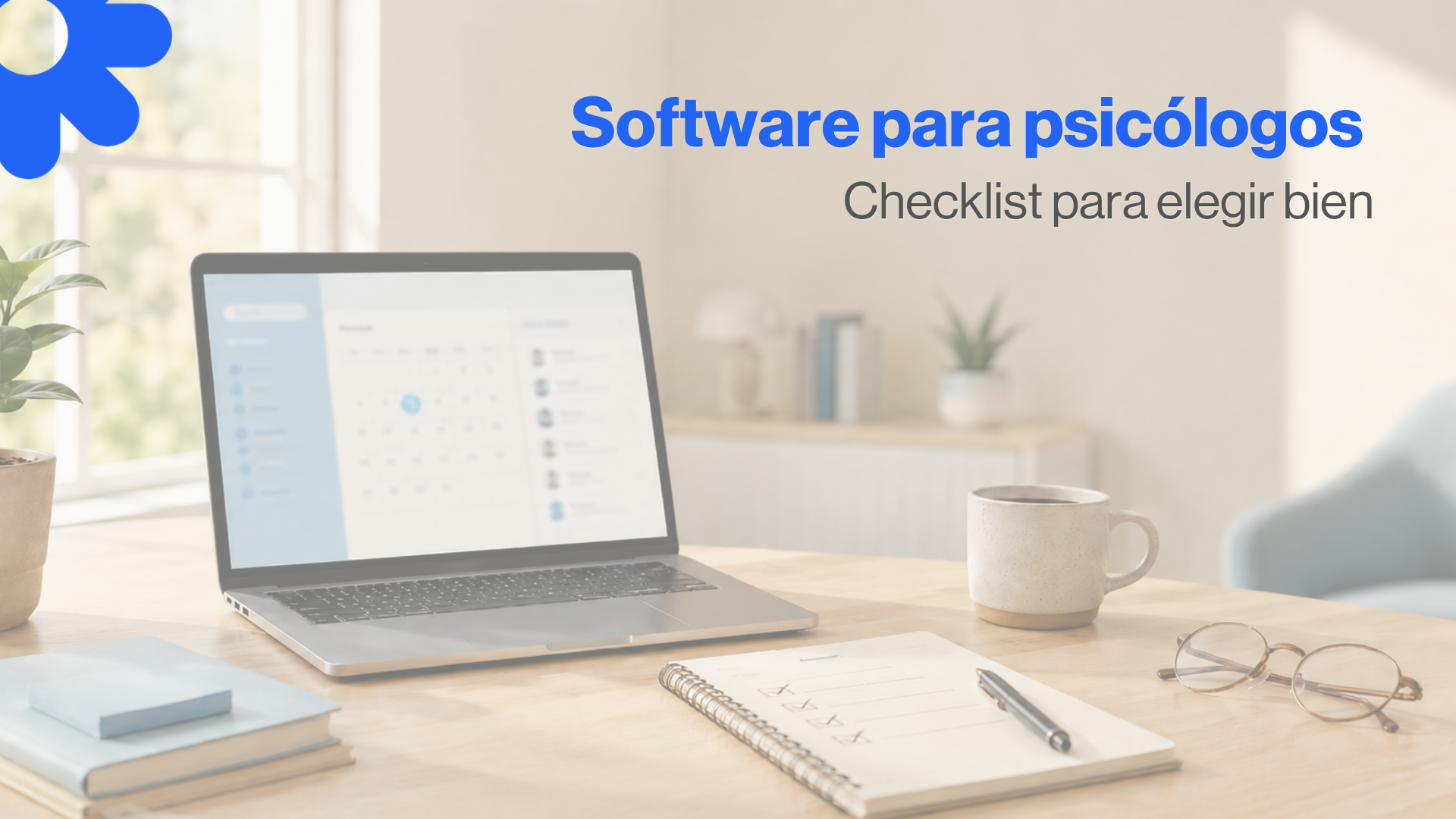
I'd go for a clean desk with an open laptop displaying a clear software interface (e.g., a calendar with multiple schedules in columns, or a patient record), and next to it, a notebook with a handwritten checklist, some items crossed off. This literally connects with the title (choosing + checklist) and the product, without being a product screenshot.
More conceptual alternative: several different software mockups on a table (paper, digital mockups) with a hand pointing to one, evoking the moment of decision.




.webp)
.webp)
.webp)
.webp)
.webp)
.webp)
.webp)
.webp)

.png)