


October 6, 2026
How to reduce no-shows just when your schedule is at its fullestReminders, cancellation policies, and flexibility: how to prevent no-shows from costing you hours just when your schedule is at its fullest.
If you have several people in your center and the agenda starts to “rule” more than necessary, it's not that you lack organization. The thing is that, from a certain point on, a calendar is no longer enough.
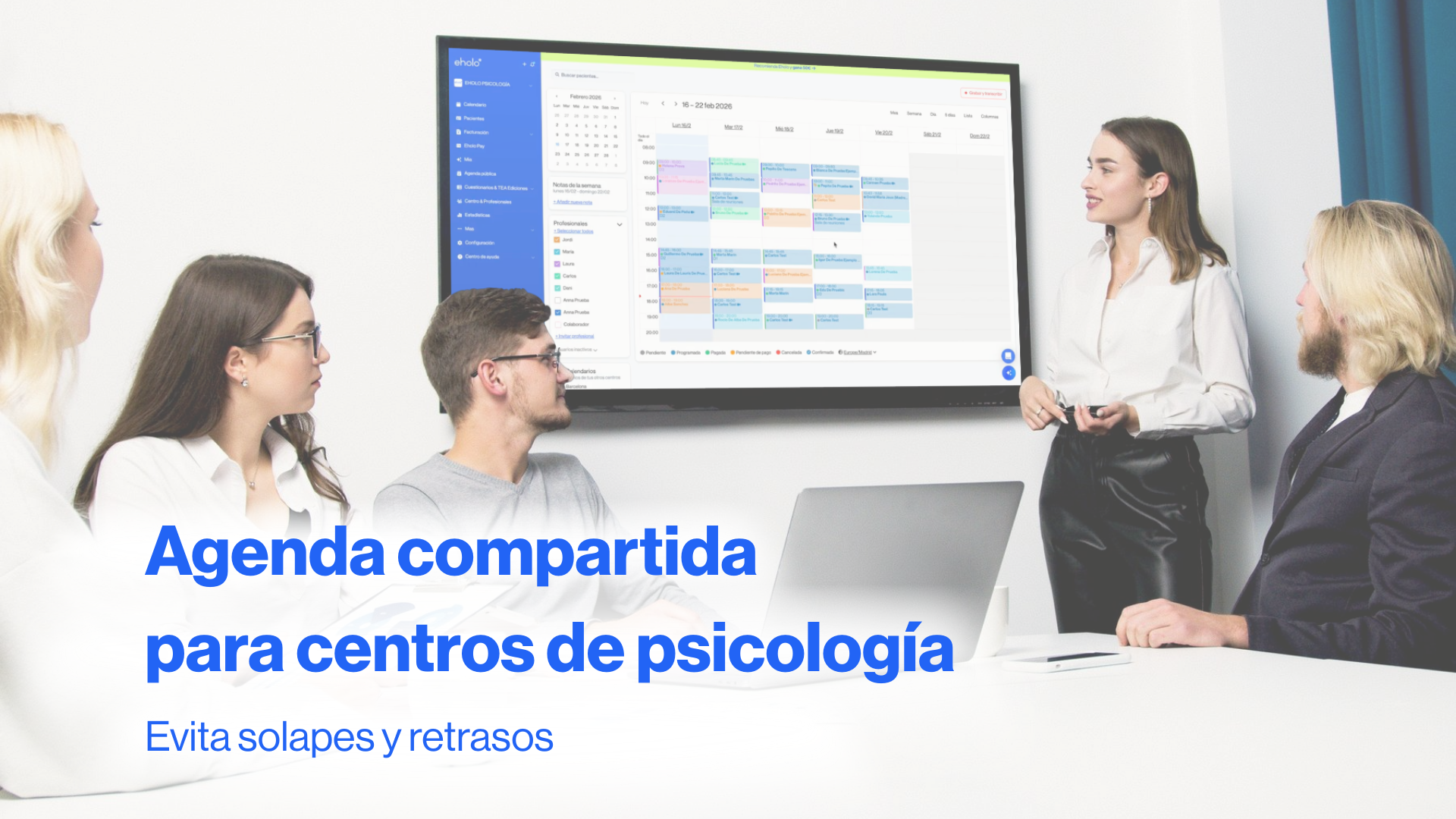
A shared agenda isn't just about “seeing what's there”. It's being able to coordinate without asking questions all day long. It is to avoid overlaps and chain delays. It's protecting transitions. And, above all, it's taking the mental burden off the team.
In this article I give you a clear and practical guide to having a shared agenda in a psychology center that really works: without rigidity, with judgment, and without looking like a manual.
The agenda is broken in very recognizable ways: two appointments at a time, a double reserved room, last-minute changes that are resolved by WhatsApp, chain delays, patients who are not sure if the session is online or in person, psychologists who end up coordinating even if it's not their turn.
None of this is rare. This is typical when there are several professionals and there is no common system.
Una shared agenda It is a system where the center can coordinate people, spaces and rules: who attends, when, in what modality, in what room and with what criteria changes and cancellations are managed.
What doesn't work is a shared calendar without rules, where everyone can move everything. There the center depends on messages, favors and memory. And that tires.
The goal isn't to fill in gaps; it's work more fluently, without losing control.
Overlaps are almost never overlooked. They happen because the system allows it.
To avoid this, you need three simple things:
A single source of truth: if there are two parallel calendars (personal + center, or agenda + Excel), there will be errors. Not out of bad faith: out of pure logistics.
Appointment types with predefined durations: when every appointment is created “by eye”, the agenda becomes fragile. Define standard durations (first visit, follow-up, partner, evaluation...) and always use them.
Rooms as a resource (if you work in person): if you work in person, a room cannot be an informal arrangement. It should be a resource that is reserved just as the therapist's time is reserved. If not, the usual thing ends up happening: two people with the same room.
Practical tip: If you have overlaps today, check if the origin is in a dual system or in rooms that are not reserved. In most centers, the problem is usually there.
In psychotherapy, the change from one session to another is not neutral. There is closure, notes, regulation. Sometimes a session removes. Sometimes you have to write down the essentials before it gets lost. Sometimes you just need two minutes of silence.
When the agenda does not contemplate this, the typical pattern appears: you try to be punctual, but the day pushes you to run. And when the rush sets in, the most important thing is resented: clinical presence.
A change of view usually helps here: margin is not “wasted time”, it is Time to take care of the process. A short gap between sessions, well placed, reduces chain delays and makes the day more sustainable.
You can start with a simple rule: minimum margin between follow-ups, larger margin on first visits or evaluations, and different margins depending on the modality (in personal/online). It doesn't have to be perfect, it needs to exist.
In centers, chaos often doesn't come from appointments, but from details: if it's in person or online, what room it's in, if there are room changes, if that session requires more preparation.
It helps a lot if the agenda shows clearly and without extra effort:
When this is good, an invisible tension decreases: that of solving micro-incidents all day long.
A well-configured shared agenda doesn't mean that everyone can do everything. It means that every role has access to what it needs, and nothing else.
A typical cast that works well:
This is not about control for the sake of control. It's about avoiding errors, reducing noise and protecting confidentiality.
The changes are going to happen. The difference is in how they are held up.
A center works more fluently when there is:
This avoids two exhausting things: constant improvisation and internal conflicts. If there's no common ground, it's easy for the team to feel that the burden isn't evenly distributed. With a minimum protocol, that feeling goes down and the agenda is managed more calmly.
If you need a quick impact, start here:
With this, many schools go from keeping up with the agenda to work more calmly and fluidly.
It shows in small things: fewer messages to coordinate the basics, less haste between sessions, less confusion with rooms and modalities, and more sense of control without rigidity.
And that feeling is valuable. Because it gives you back energy for what's important: the clinic.
At Eholo, the shared agenda for centers is designed so that the team coordinates fluidly and without losing control. The idea is simple: that the agenda is a stable system and that frees the therapist from logistics.
On a daily basis, it allows you to:
Setting it up is easy because it doesn't start with infinite configurations, but with basic decisions: appointment types, recommended margins, roles and, if applicable, rooms. With that, you can already see the change: fewer interruptions, less improvisation and more sense of control.
And the benefits are obvious and fast: more punctuality and fewer chain delays. Less mental burden for coordination and therapists. Less confusion for the patient. And a solid base for growth without the agenda becoming the problem.
👉 View Eholo demo for centers (and review your case: number of professionals, rooms, modality and change/cancellation circuit).
Not exactly. A shared calendar gives you visibility. A shared schedule for a center includes rules, roles, rooms, appointment types, and a consistent way to manage changes.
Treating rooms as bookable resources and using a single source of truth. If the room is coordinated “by messages”, there will be conflicts sooner or later.
It depends on your practice and the modality, but a minimum margin improves punctuality and quality. Without margin, chain delay becomes structural.
Whoever has the role and the context. Usually, coordination manages changes with a protocol and for the therapist to block times and adjustments within clear limits.

Explora las últimas novedades
Reminders, cancellation policies, and flexibility: how to prevent no-shows from costing you hours just when your schedule is at its fullest.
Has your psychology practice grown? Discover the difference between multi-user and single-user software and what to look for before choosing.
Discover which tasks to automate in your practice and which ones should remain yours.


.webp)
.webp)
.webp)
.webp)
Virginia Lagartos Lopez
April 12, 2024
.webp)
Maria De Salazar Martínez
September 01, 2023
.webp)
April 2, 2024
.webp)
April 3, 2024
.webp)
January 22, 2025
Más de 10,000 psicólogos ya confían en Eholo para gestionar sus consultas.
.png)
Necesitamos saber esta información para personalizar tu demo:
